Navigating the Post-Knowledge Work Era
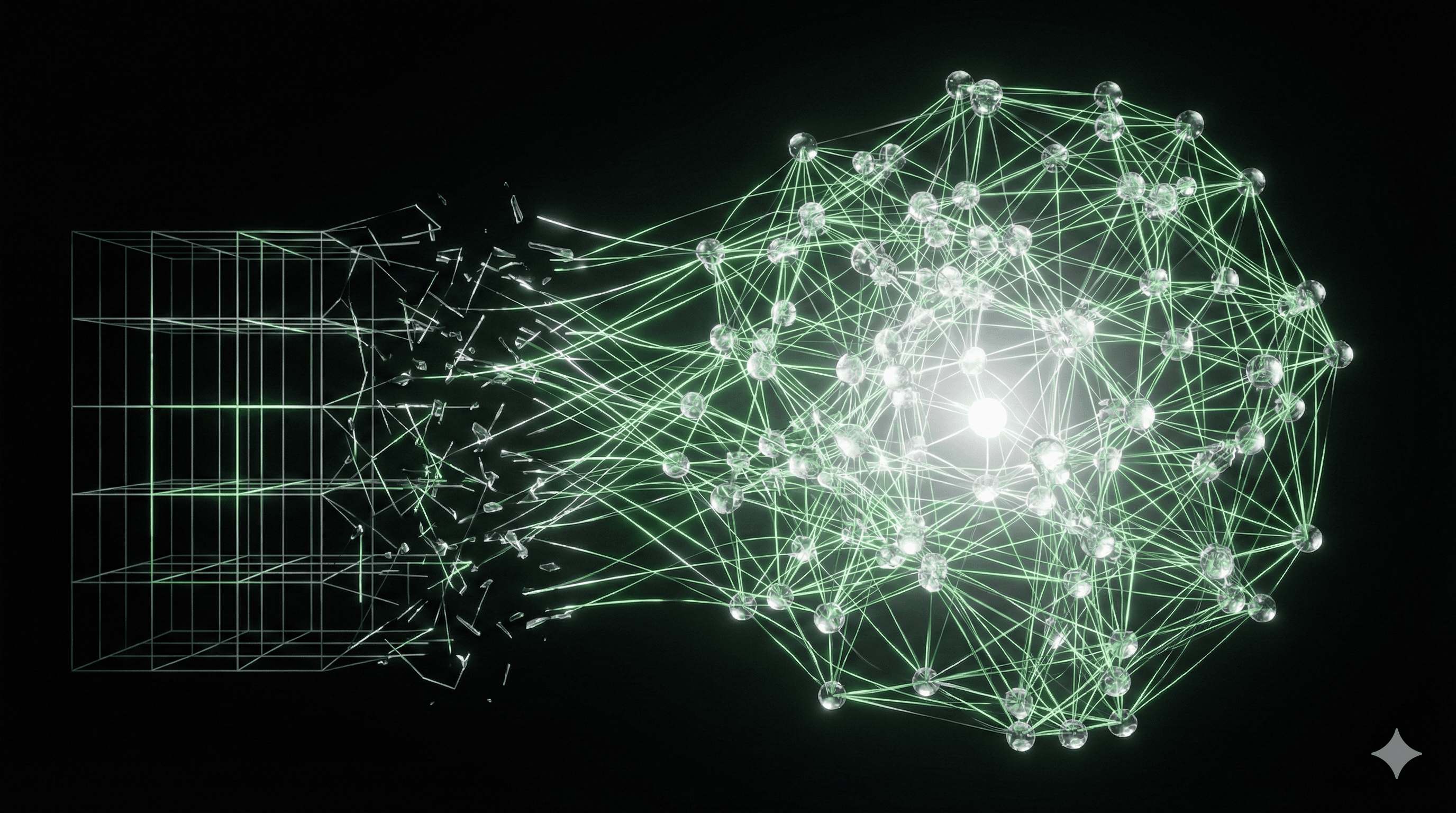
The Skill Premium Paradox
"The question that really matters is whether humans will still command a skill premium once they are augmented by machines." – Sangeet Paul Choudary
Source of the above quote. Feel uncomfortable yet?
If you don’t feel anxiety about the future of work, you likely haven't been paying attention. Since the "ChatGPT Moment," we have been hurtling toward a reality where hyper-specialization—the very thing that defined career success for decades—is becoming an inertia barrier.
We are leaving the industrial construct of "jobs" and entering the Post-Knowledge Work Era. In this era, the factor that drives our engagement is not just what we know, but how adaptable we are when our knowledge is commoditized by machines. The Network-First Future of Work will be where the adaptation is encapsulated.
1. The Shift: From SaaS to Service-as-Software
If you observe the signal amidst the noise, one thing is clear: The future of Generative AI is Agentic, Multimodal, and Multimodal.
We are witnessing the death of traditional Software as a Service (SaaS). In its place, Service-as-Software is emerging. This is not just a semantic change; it is a structural revolution.
- Compound AI Systems are replacing isolated models.
- Contextual AI is merging with Spatial Computing to understand what we see and hear in real-time.
This transition is already sending shockwaves through the software industry. It is creating a reality where the human touch on a computer is automated away, solving the "last mile" challenges of Conversational AI.
2. Signal Spotlight: The Foundation Capital Series
My purpose is to spotlight the thought leadership that lights the path forward. Today, I attribute these insights to Joanne Chen, Jaya Gupta, and Ashu Garg at Foundation Capital.
To prepare for the Intelligence Age, these are your essential reads:
- The Foundation: The Future of Generative AI Agents (Chen)
- The Shift: AI Leads a Service-as-Software Paradigm Shift (Chen, Gupta)
- The Promise: The Promise of Multi-Agent AI (Chen)
- The Architecture: A System of Agents Brings Service-as-Software to Life (Chen, Gupta)
- The Disruption: How Systems of Agents Will Collapse the Enterprise Stack (Garg, Gupta)
- The Paradox: Teaching AI to Teach Itself (Chen)
3. The Goal: Organizational Artificial General Intelligence (OAGI)
How does a legacy organization survive this exponential disruption? It must become a Complex Adaptive System (CAS).
We must stop treating organizations as static hierarchies and start treating them as living organisms. The goal is to achieve Organizational Artificial General Intelligence (OAGI)—a state where the organization itself possesses the adaptability and reasoning of a Level 5 AI system (as defined by OpenAI).
This requires giving AI agents an ontological view of the enterprise. We may even need to create "digital twins" of our organizations for simulation purposes, allowing us to test resiliency before chaos strikes.
4. The Human Challenge: Paralysis by Excellence
Here lies the hardest truth: Excellence can be the ultimate inertia barrier.
Call it "Paralysis by Excellence." The decade you spent mastering a specific, rigid process is now a liability. That mastery creates resistance to change.
In the Post-Knowledge Work Era, we must "unwind" this hyper-specialization. We must decouple the value we create from the underlying business processes we once managed.
- The Old Way: Humans execute rigid processes supported by software.
- The New Way: Humans architect Value Networks where AI agents execute the work.
5. The Path Forward
The stability of our economies depends on our ability to navigate this "Jobs to Skills" transition. We must displace the century-old org chart with the Networked Organization.
Deflation in the cost of goods will not happen fast enough to offset the displacement of jobs. We cannot wait for governments to intervene. We must act now to increase our own "economic agency."
Don't let your expertise become your cage. Adapt, or become obsolete.
Attribution & Acknowledgement
This blog draws upon the insightful work of the amazing, previously attributed authors and thought leaders who have generously shared their research and ideas. In many cases, The Value Network has intentionally included direct quotes to properly attribute their contributions and maintain the integrity of their original thoughts, in the context for which they were stated. While we have taken care to avoid misinterpreting the source material, the conclusions drawn in this blog are our own and reflect our current understanding and coherence within an ongoing discovery and learning process. As such, the author of this post is accountable for any misrepresentations that may arise.